News
How Do Slewing Ring Bearing Manufacturers Ensure Exceptional Rotational Precision?
For heavy equipment buyers, mechanical engineers, and project decision-makers from Southeast Asian regions such as the Philippines, Indonesia, Vietnam, and Thailand, rotational precision is a critical performance metric when selecting slewing ring bearings. It directly impacts equipment stability, operational efficiency, and service life. So how does a top-tier slewing ring bearing manufacturer guarantee this core performance throughout the entire process, from production to delivery?
I. Understanding Rotational Precision: Why It Matters
Rotational precision refers to the smoothness and permissible deviation range when the inner and outer rings of a slewing ring bearing rotate relative to each other under load. Insufficient precision can cause equipment vibration, abnormal noise, accelerated wear, and even cracks in critical structural components. For port cranes, excavators, concrete pump trucks, and offshore platforms widely used in Southeast Asia, precision stability faces severe challenges in tropical climates characterized by high humidity, high salinity, and frequent heavy rains. Therefore, selecting a manufacturer that guarantees long-term precision is key to securing a sound return on investment.
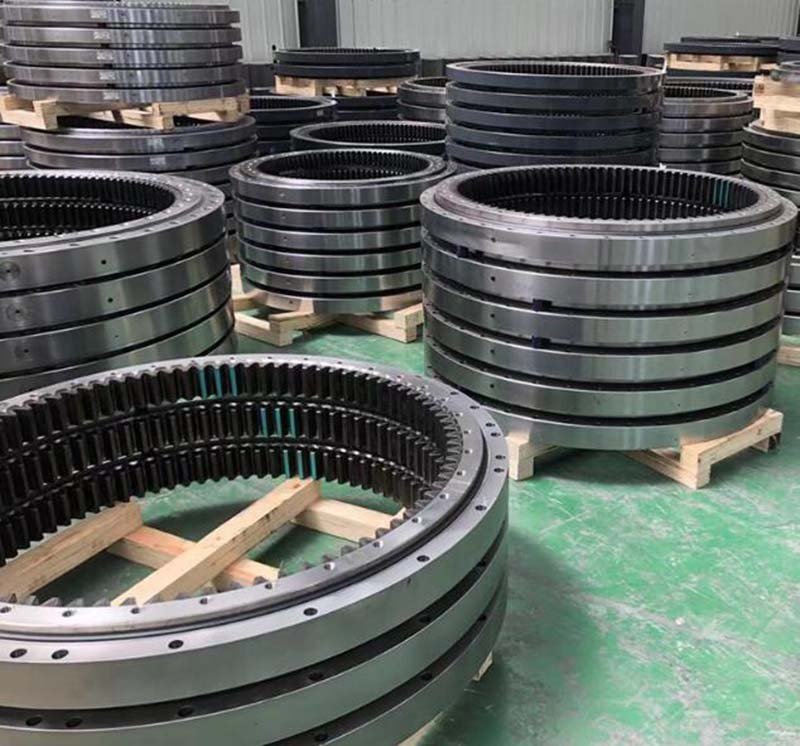
II. Core Manufacturing Processes: The Foundation of High-Precision Machining
Precision is not accidental but stems from rigorous manufacturing control. Reputable manufacturers exercise control from the outset:
1. Precision CNC Machining: The raceway of the bearing seat is the core determinant of precision. Manufacturers must employ advanced five-axis CNC machines for milling and grinding to ensure the raceway's geometric shape, surface finish, and post-heat-treatment deformation are controlled at the micrometer (μm) level. This level of precision is unattainable with manual or semi-automatic equipment.
2. Heat Treatment Technology: Southeast Asia's high-temperature, high-humidity climate accelerates material corrosion and deformation. Superior manufacturers employ processes like carburizing and quenching to create extremely hard, wear-resistant raceway surfaces while maintaining core toughness. This ensures dimensional stability and deformation resistance under heavy loads and impacts.
3. Precise Roller Selection: For the single-row crossed roller slewing bearings you mentioned, dimensional consistency of the 1:1 crossed rollers is critical. Manufacturers use precision measuring instruments to sort and group each roller, ensuring minimal dimensional deviation within a single bearing set. This achieves smooth, jam-free rotation.
III. Rigorous Quality Inspection: Data-Driven Verification
“Trust, but verify.” Reputable manufacturers never bypass rigorous testing procedures.
* Coordinate Measuring Machine (CMM): Used for comprehensive inspection of seat ring dimensions, roundness, flatness, and concentricity, generating detailed inspection reports. This provides hard evidence of precision compliance with international standards like ISO, GB, or JIS.
* Dedicated Raceway Precision Tester: This specialized equipment simulates real-world conditions to precisely measure raceway run-out and rotational torque, ensuring smooth rotation without abnormal noise.
* Surface Flaw Detection: Employing Magnetic Particle Inspection (MPI) or Ultrasonic Testing (UT), this process ensures no microscopic cracks or defects exist in raceways or gear teeth. Such flaws can propagate under heavy loads, causing rapid precision loss.
IV. Professional Installation Guidance and After-Sales Support: The Final Mile of Precision
A common misconception is focusing solely on the product itself while neglecting installation. In Southeast Asia, where on-site technical expertise may vary, manufacturer technical support becomes particularly crucial.
a: Detailed Installation Manuals (Multilingual): Reputable manufacturers provide clear installation guides in English and even Vietnamese, Thai, and other languages. These manuals specify proper cleaning procedures, hoisting techniques, bolt tightening protocols (requiring diagonal tightening), gear meshing clearance adjustments, and initial lubrication.
b: Remote technical support: When your team encounters installation questions at a mine in Indonesia or a port in the Philippines, can they quickly access technical support from the manufacturer's engineers via WhatsApp, email, or video call? This is crucial.
c: Preventive Maintenance Recommendations: High humidity accelerates grease degradation and corrosion. The manufacturer should provide lubrication recommendations tailored for tropical climates (e.g., using high-viscosity, water-resistant grease) and regular inspection protocols to help maintain rotational precision and extend product lifespan.
Ensuring slewing ring rotational precision is a systematic endeavor, encompassing every stage from premium raw materials and cutting-edge manufacturing processes to rigorous quality inspections and lifetime technical support. For users in the Southeast Asian market, selecting a partner that delivers not just products but comprehensive Total Solutions is the fundamental guarantee for stable, efficient, and long-term operation of your machinery in challenging environments. Before making a decision, ensure thorough communication and verification. This will spare your project future complications and maximize your investment value.
Categories
Latest News
- What is the working principle of slewing bearings?
- What is a Slewing Bearing? An In-Depth Look at Its Core Components
- How Do Slewing Ring Bearing Manufacturers Ensure Exceptional Rotational Precision?
- How to Choose the Right Slewing Bearing Manufacturer
- How to Effectively Evaluate a Slewing Bearing Manufacturer