News
What Should You Look for When Choosing a Slewing Bearing Manufacturer? 5 Core Dimensions
As the “joint” component for construction machinery, wind power equipment, and port machinery, the quality of slewing bearings directly determines equipment lifespan and operational safety. For customers, selecting a reliable slewing bearing manufacturer requires not only meeting localized needs but also balancing international standards with long-term partnership stability. The following five dimensions serve as key criteria for screening high-quality slewing bearing manufacturers.
1. Prioritize Quality Certifications and Full-Process Quality Control
U.S. clients demand stringent compliance, while Southeast Asian customers emphasize durability. This necessitates manufacturers possessing comprehensive quality systems. First, examine certification credentials: Have they obtained ISO 9001 Quality Management System, ISO 14001 Environmental Management System, as well as localized standards like U.S. API certification (for petroleum machinery) and Southeast Asia's TISI certification (Thailand)? Professional manufacturers will disclose raw material inspection reports—for instance, providing chemical composition analysis and hardness test data for 42CrMo alloy steel. During production, ensure precision is maintained through equipment like CNC vertical lathes and automated heat treatment lines (e.g., controlling raceway tolerances within 0.05mm). Additionally, verify factory inspection reports from third-party testing agencies, as these represent hard quality metrics.
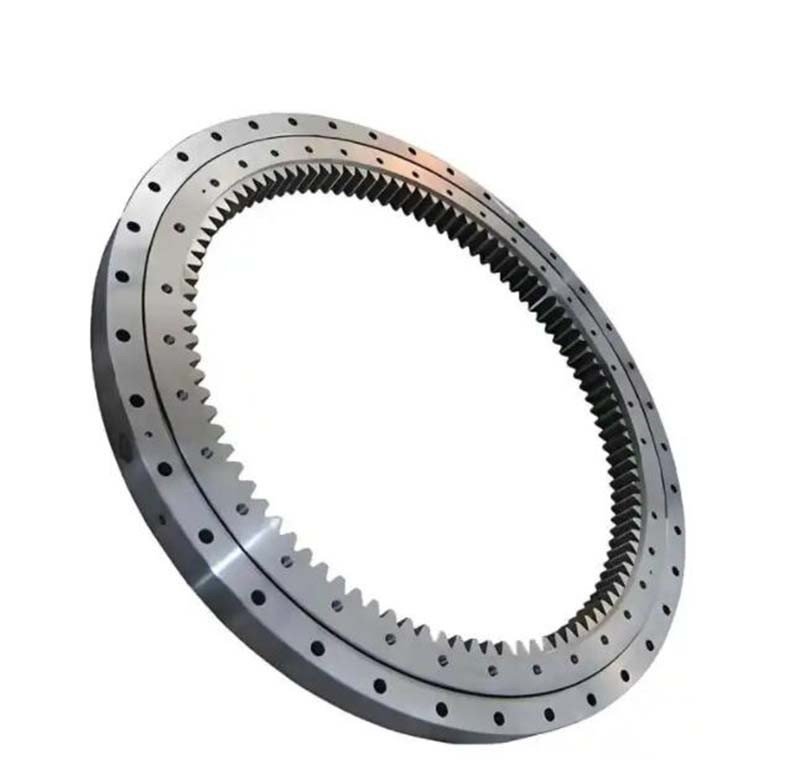
II. Focus on R&D and Customization Capabilities
U.S. clients often require high-precision solutions for wind power and premium agricultural machinery, while Southeast Asian clients prioritize compact construction equipment (e.g., excavators, loaders). This demands flexible technical adaptation from slewing ring manufacturers. Premium slewing bearing manufacturers maintain dedicated R&D teams—such as engineers with over 10 years of industry experience—capable of tailoring structural solutions based on client equipment parameters (e.g., load capacity, rotational speed, environmental humidity). Examples include optimizing seal designs for Southeast Asia's high-temperature, high-humidity regions and developing large-diameter (over 3 meters) monolithic slewing bearings for U.S. wind power projects. Additionally, reviewing a manufacturer's patent portfolio (e.g., patents related to corrosion resistance and noise reduction) provides a direct indicator of their technological capabilities.
III. Assessing Production Capacity and Delivery Efficiency
Southeast Asian clients are highly affected by supply chain cycles, while U.S. clients prioritize batch order stability. Therefore, a slewing ring manufacturer's production capacity and logistics layout are critical. It is essential to understand the manufacturer's annual production capacity (e.g., whether it exceeds 50,000 sets), the number of production lines, and whether they have established warehousing centers in key regions. For instance: - Equipment component warehouses in Thailand and Vietnam can shorten delivery cycles for Southeast Asian clients to 7-10 days. Partnering with logistics providers at U.S. ports like Los Angeles and Houston reduces transoceanic shipping costs. Additionally, manufacturers' inventory management capabilities are vital—ensuring common models (e.g., single-row four-point contact ball slewing bearings) are readily available prevents customer equipment downtime due to stockouts.
IV. Prioritizing Localized Service and After-Sales Support
In cross-regional collaborations, after-sales response speed directly impacts customer experience. Reliable slewing bearing manufacturers establish localized service networks: setting up after-sales offices in the U.S. for 24/7 technical consultation; deploying maintenance engineers in Southeast Asian countries like Indonesia and Malaysia to ensure on-site resolution within 48 hours of equipment failure. Additionally, whether manufacturers offer lifetime technical guidance (e.g., regular maintenance recommendations) and rapid spare parts replenishment services is a vital consideration for long-term partnerships.
V. Balancing Cost and Value for Money
Southeast Asian clients prioritize cost control, while American clients emphasize return on investment. However, “low price” must never be the sole criterion for selecting a slewing ring manufacturer. Compare manufacturers' pricing logic: Do they reduce unit costs through economies of scale (e.g., annual sales exceeding 30,000 units) without compromising quality? Do they provide transparent quotations (including breakdowns of raw materials, processing, and logistics costs) to avoid hidden fees? For instance, a global slewing ring manufacturer optimizes its supply chain by establishing raw material procurement points in Southeast Asia. This approach keeps product pricing within a reasonable range while ensuring quality through ISO certification, making such enterprises a priority choice.
For customers, selecting a slewing ring manufacturer is not a “one-time purchase” but a process of screening for a “long-term partner.” From quality certifications to after-sales support, from technical customization to cost control, only through comprehensive evaluation and rigorous scrutiny can one identify a high-quality slewing ring manufacturer that aligns with their specific needs, laying a solid foundation for stable equipment operation and business growth.
Categories
Latest News
- What is the working principle of slewing bearings?
- What is a Slewing Bearing? An In-Depth Look at Its Core Components
- How Do Slewing Ring Bearing Manufacturers Ensure Exceptional Rotational Precision?
- How to Choose the Right Slewing Bearing Manufacturer
- How to Effectively Evaluate a Slewing Bearing Manufacturer