News
Slewing Bearing Rotation Failure? Scenario-Based Solution Guide
The rotary bearing is the core component enabling equipment rotation. Should rotation failure occur, precise troubleshooting must be conducted based on the usage stage. Below are specific solutions for three scenarios: “High-Speed Failure After Purchase,” “Operation Failure After Installation,” and “Operation Failure During Use.” It is also recommended to promptly contact the rotary bearing manufacturer or supplier for technical support to ensure efficient problem resolution.
I. Rotation Failure at High Speeds After Purchase
If a newly purchased slewing bearing fails during high-speed operation, follow these troubleshooting steps:Check for Transport Damage: First, verify if the slewing bearing sustained impacts, compression, or other damage during transit. Damage typically manifests as abnormal noise. In such cases, immediately cease operation and contact the slewing bearing manufacturer's after-sales service center. Reputable manufacturers provide rapid response to assess damage severity and develop repair or replacement plans, preventing subsequent equipment failures.
Investigate environmental temperature impact: In cold regions (e.g., northern U.S., high-altitude areas of Southeast Asia during winter), consider the increased viscosity of lubricating grease in the raceway due to low temperatures, which directly causes reduced rotational responsiveness. Attempt adjusting the equipment operating speed. If the slewing bearing rotates normally without other abnormalities (e.g., unusual noises, stuttering) after speed adjustment, proceed with normal operation. If the issue persists after adjustment, contact the slewing bearing manufacturer to obtain a lubricant grade suitable for low-temperature environments. Test again after replacement.
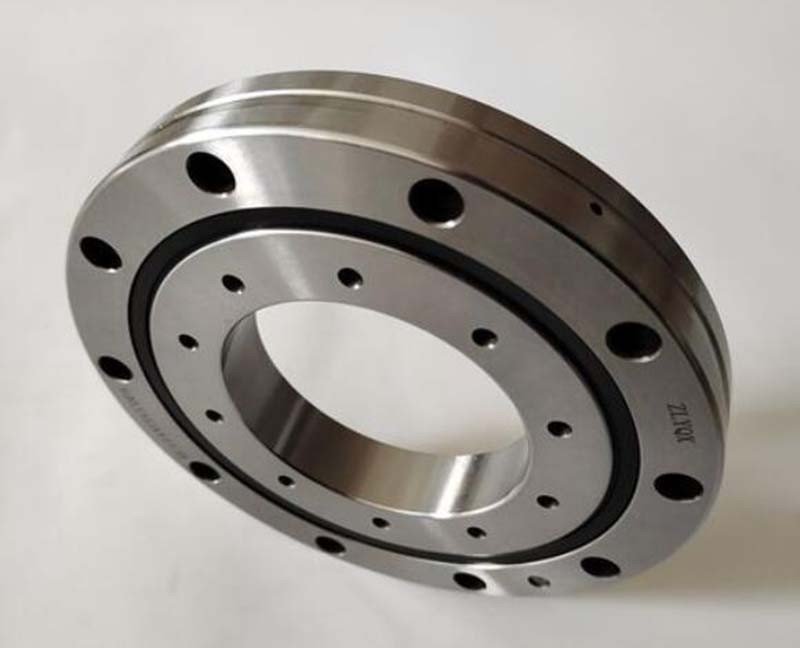
II. Rotation Failure During Operation After Equipment Installation
a. Rotation failure occurring after the slewing bearing is installed on the host machine is often related to installation compatibility. Specific causes and solutions are as follows:
b. Poor Installation Surface Fit: If the flatness or conformity of the host machine's mounting surface does not meet standards relative to the slewing bearing's bearing mounting surface, the radial clearance cannot compensate for deformation after installation. This forces the slewing bearing into a negative clearance state, ultimately causing rolling elements to operate with difficulty within the raceway (often accompanied by abnormal noise).
c. Solution: Re-machine the host machine mounting surface to meet the installation standards provided by the slewing bearing manufacturer. If machining is impractical, use shims to compensate for clearance. Contact the slewing bearing manufacturer's technical team for assistance in verifying mounting surface accuracy to avoid secondary issues from improper DIY adjustments.
d. Gear meshing issues: Improper meshing clearance between the large and small gears, or foreign objects lodged in the meshing area, can also cause the slewing bearing to fail to rotate.
e. Solutions: ① Readjust the meshing clearance of the large and small gears according to the technical parameters provided by the slewing bearing manufacturer, with particular attention to calibrating the direction where gear vibration is most pronounced; ② Thoroughly clean the gear meshing area. Confirm the absence of metal debris, dust, or other foreign objects before test operation.
III. Rotation Failure During Long-Term Use
a. If the slewing bearing suddenly fails to rotate after prolonged use, it is often related to routine maintenance or component wear. Specific troubleshooting directions are as follows:
b. Insufficient Lubricant: Lack of lubricant is a common cause of rotation failure. Inspect the lubricant level in the raceway according to the manufacturer's maintenance manual. If insufficient, promptly replenish with the appropriate grade of lubricant (different operating conditions, such as construction machinery or wind power equipment, require corresponding anti-wear and high-temperature resistant greases; consult the slewing bearing manufacturer for recommended grades).
c. Damaged Sealing Strip: In dusty environments (e.g., Southeast Asian construction sites, U.S. mining operations), a damaged sealing strip allows foreign particles to enter the raceway, obstructing rotation.
d. Solution: First, stop the equipment. Disassemble and remove foreign objects from the raceway, then replace the seal with a new one. It is recommended to use genuine parts from the slewing bearing manufacturer to ensure sealing performance and compatibility with the slewing bearing, preventing subsequent foreign object ingress.
e. Gear Wear or Foreign Object Jam: Re-examine the meshing condition of the large and small gears to confirm whether there is gear tooth breakage, excessive wear, or large foreign objects jammed in the meshing area. If gear wear is detected, contact the slewing bearing manufacturer to confirm gear specifications and have them replaced by professionals to avoid non-compliant meshing accuracy due to self-replacement.
Slewing Bearing Manufacturer's Friendly Reminder:
When encountering slewing bearing rotation failure that cannot be resolved through self-troubleshooting, never force the equipment to start. This prevents secondary damage to the slewing bearing or host components. It is recommended to prioritize contacting the original slewing bearing manufacturer or their authorized service center. Provide detailed information including equipment model, operating conditions, and failure symptoms. Reputable slewing bearing manufacturers will swiftly diagnose and resolve the issue through remote guidance or on-site service, ensuring the equipment resumes normal operation as soon as possible.
Categories
Latest News
- What is the working principle of slewing bearings?
- What is a Slewing Bearing? An In-Depth Look at Its Core Components
- How Do Slewing Ring Bearing Manufacturers Ensure Exceptional Rotational Precision?
- How to Choose the Right Slewing Bearing Manufacturer
- How to Effectively Evaluate a Slewing Bearing Manufacturer